
” The clouds form when summertime wisps of water vapor rise up to the mesosphere, allowing water to crystallize around specks of meteor smoke. ” ~ This is such a nonsense theory. How does water vapor rise in a temperature that goes from 0*C at the Stratopause to -180*C at the mesopause? How is water vapor even existing in those temperatures in this vacuum?
“Noctilucent clouds have been likened to a great “geophysical light bulb” because they turn on abruptly, reaching almost full intensity over a period of ~10 days. ” ~ This is a significant clue. They intensify as the maximum hours of sunlight is approaching and then shutting down as the equinox approaches and the hours of sunlight decreases. In other words, as solar insolation increases these clouds appear. This to me seems more like an ionizing event.
Since nitrogen is just as common in the mesosphere as it is in the troposphere at 78%, I am more inclined to think these noctilucent clouds are not water vapour but perhaps nitrogen vapour. Temperature present isn’t quite low enough to liquify nitrogen, but might be low enough to produce a vapour. Ionized nitrogen in a low pressure environment will glow with a blue hue.
I propose these noctilucent clouds are actually the product of slightly ionized liquid nitrogen in a low pressure environment.

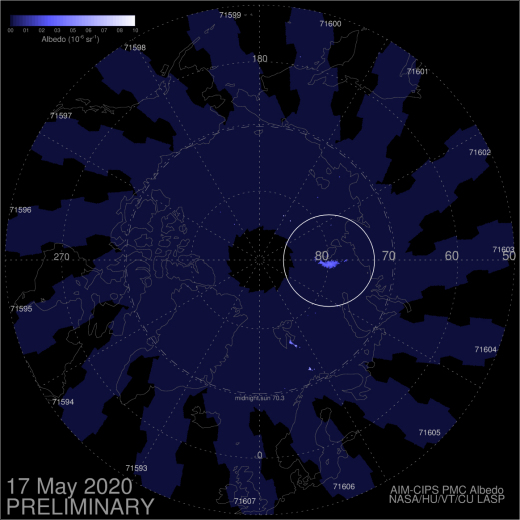
May 28, 2020: On May 17th, NASA’s AIM spacecraft detected the first noctilucent clouds (NLCs) of summer. Those first electric-blue smudges were barely visible. Since then, however, the clouds have rapidly intensified. Recent images from orbit show a growing bank of NLCs pinwheeling just inside the Arctic Circle:
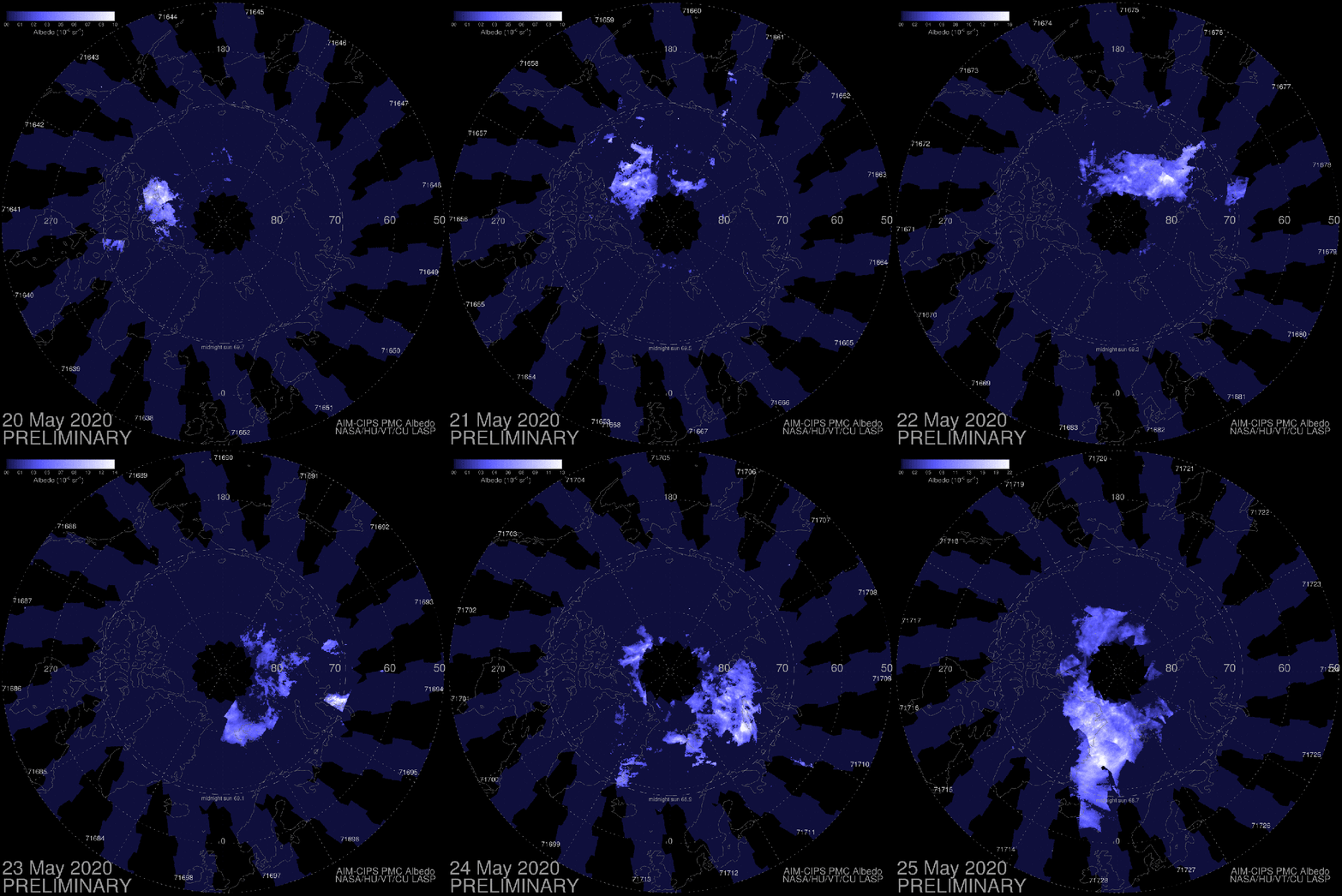
NLCs are Earth’s highest clouds. Seeded by meteoroids, they float at the edge of space more than 80 km above the ground. The clouds form when summertime wisps of water vapor rise up to the mesosphere, allowing water to crystallize around specks of meteor smoke. Last summer, they spread as far south as Los Angeles and Las Vegas, setting records for low-latitude sightings.
It’s early in the 2020 season, so the clouds are still concentrated around the North Pole. Nevertheless, people in Europe are starting to see them. Johny Krahbichler sends this picture taken last night (May 26th) from…
View original post 153 more words

 THE UNOFFICIAL NATURAL PHILOSOPHER